
Mountain Trek on Abuna Yoseph- 6 days
Explore Tours
Trip Code: ZET 040
Mode of Transportation: Air and Surface (Minibus)
Tour Type: Community Trekking -Eco-tourism
Length: 6 days / 5 nights
Group Size: 1- 15 Participants
Dates: Any date departure
Difficulty: Hard
Altitude: 2,500 — 4000 M
Trek through the timeless highlands of Wollo near Ethiopia’s ancient Christian pilgrimage site, Lalibela.
This five days walk takes you across a plateau of dry farming and grazing land, returning repeatedly to escarpments offering breathtaking views of the valleys below.
As well as the rock churches of Lalibela, walks here can be easily combined with visits to the old capital Gondar, and Lake Tana, source of the Blue Nile and home to abundant bird life.
This walk is in remote mountains, on which you will have to be self-sufficient.
You get a fascinating look into rural life essentially unchanged for centuries. Children herd sheep, donkeys and cattle as parents stack hay beside round “tukul” houses of packed earth. There is no electricity or machinery, even plastic is rare.
The trek, organized by Tesfa Community , is part of a scheme providing income for villagers who guide and cater for visitors in simple but clean lodges owned by the community. Each lodge sits right on the edge of the escarpment and built out of native materials, the guest houses include comfortable beds, clean sheets, and blankets. Each site has a dining room, shower, and toilet. Upon arrival travelers can enjoy a spectacular sunset view, freshly-pounded Ethiopian coffee in hand.
Due to the altitude in Abuna Yosef, most treks are rugged and visitors should be prepared.
Gelada baboons, unique to Ethiopia, clamber in large packs across cliffs. Vultures, augur buzzards and occasionally giant lammergeyers soar above.
With the third highest peak in Ethiopia, the Abuna Yosef massif offers visitors stunning views and wildlife viewing opportunities. During the five day treks in Abuna Yosef, visitors can see an impressive array of flora and fauna.including giant lobelia, troops of gelada baboons, and the rare Ethiopia wolf.
Treks in Abuna Yosef bring visitors to over 4,300m and are not for the faint of heart. However, those that make the climb find the views and experience well worth it!
Included/Exclude
Tour Amenities
Tour Plan
Today we fly to Lalibela, Ethiopia’s cultural crown jewel. A cradle of Ethiopian Christianity, Lalibela is famed for its magnificent ancient churches and is the scene of many major religious ceremonies. Christianity in Ethiopia dates to the 1st century AD, the only pre-colonial Christian presence in sub-Saharan Africa and one of the oldest Christian communities in the world. Today, about 60 percent of Ethiopia’s people, with most part of the orthodox tradition.
Often called the eighth wonder of the world, Lalibela’s mystical rock-hewn churches evoke a profound sense of awe and admiration. Churches below ground level are carved straight from the rock, ringed by trenches and subterranean courtyards and connected by a maze of stone tunnels and passages. Of these, Bete Giyorgis is most famous and most photographed, as it is unobscured by any shelters erected over the site. The churches above ground are equally wondrous feats of engineering, built out of a single hunk of rock, using no blocks, bricks, joints, seams or mortar. While individual churches are often built in the shape of a cross, multiple churches together also form a larger cross. Among the churches we will visit is Bete Amanuel, a 36-foot-high monolith considered by architectural historians to exhibit the finest and most precise workmanship in Lalibela. Bete Medhane is the largest of Lalibela's churches and the largest human-carved monolith in the world, while the most majestic and best preserved of all Lalibela’s churches is Bete Markorios, a cave church originally used for secular purposes and thought to be approximately 1,400 years old.
Meals: B/LD
Overnight: Tukul
after early breakfast drive to Meket , where we start trek .after 3 hours of walking arrive to Mekote.
Mekuate mariam is one of the oldest campsites of all , it is situated at an altitude of 2820m South East of lalibela .it takes about three hours of driving to get to trek starting place. The trekking is easy ,mekuate campsite is famouse for hosting brad pitt in 2004. The community is consists of 288 house holds, Mekete escarpment is part of Ethiopian plateau, there are about seven campsites laying on the escarpment. At Mekuate Mariam you can enjoy lammergeyers, vultures, buzzard, kites, ravens and many other birds soar over the site, it boasts a ‘rock bar’ a smooth sheltered ledge that is warmed by the afternoon sun and invites guests sit with a sundown drink a watch the golden glow at the end of the day turn red as the sun sets over mount Guna.
Meals: B/LD
Overnight: Tukul
Wajela is the second campsite site on mekete escarpment, it is situated at about 2803m above sea level, the trek involves gentle stroll along the magnificent views, across the escarpment .what makes wajela so special, it sits on the age of a cliff surrounded by the ancient villages and the campsite faces cave complex and the old church of weketa mariam set among juniper woodland .
Meals: B/LD
Overnight: Tukul
Aterow is the third campsite on mekete escarpment; it is situated at about–3000m above sea level. The campsite is–near to seasonal waterfall and some old–cave churches, it is mostly a playing ground for gelada baboons. It is a perfect site to enjoy their (baboons) company. The community is consists of 88 households. Aterow is famous for its
Striking chasm stretching across the escarpment.
Meals: B/LD
Overnight: Tukul
after 1 and half hour walking meet the car and drop at Lalibela airport and Back to Addis Ababa .We fly back to Addis this morning.
Meals: B/LD
End of the Tour and Departure
- This trip can be tailor made throughout the year to suit your requirement.
Date and Availability = All the year This trip can be tailor made throughout the year to suit your requirement and itinerary can be adjusted according to your time, budget and interest. Price: , if you want quotation or any other tour information about this trip we are very happy to help. Request a quote
suit your requirement and itinerary can be adjusted
Information
The sites are part of wholly community owned enterprises, run for and by the local community in which they are situated. Environmental considerations are an integral part of the enterprises.
Ecotourism is a fundamental part of the project.
- Numbers of tourists per site will be limited to 8 - 14
- Eco-toilet (dry composting urine separating toilet)
- Water available for washing, but tourists made aware of limited resource
- Shower — (sun heated water) water diverted to promote tree growth (not all sites have shower facilities - we are working on this).
- Indigenous tree planting
- Protecting cliff faces with terracing
- Encouraging local community to see flora and fauna as a resource to protect
The tourism generates incomes for some community members and the profit goes in to a fund for the whole community. The communities have received training on management and running of a business as part of the setting up process. They also gain confidence from running the community tourism to work together for joint benefit.
The communities are your hosts. Fifty-five percent of your payment goes directly to them(48% to the hosting communities and 7% to the community that provides lunch), twenty five percent goes to the guides and their business (which supports the community run trekking sites) and twenty percent goes to cover marketing costs and coordinate the bookings.
Plan your trip
Getting By plane
Ethiopian Airlines has scheduled two flights a day to Lalibela Airport. Flights are often overbooked: make sure you reconfirm your seat at least 1 day in advance and show up at the airport on time! The airport is mid-sized.
By car
The road to Lalibela is fine until you get to the village of Gashena, the last 1-2 hours consists of a small and unreliable road which is partly made of tarmac and partly sand. From Bahir Dar the drive takes about 7-8 hours and from Gondar about 10-11 hours. It is possible to rent you 4WD or minibus .
Climate
Ethiopia maybe in Africa but it is sometimes cold in the highlands (our sites range from 2,600 - 3,000 meters above sea level). Generally the sun is warm and the air is cool. Sometimes it rains, especially in the main rainy season-a veritable monsoon-between July and September. During this season the tourist sites are closed: the mud makes walking unpleasant even if it is not raining - believe me! There is a short rainy season, important to the farmers, with sporadic rain (often late in the afternoon and at night) between February and April. Sometimes the short rains come late and merge into the main rains with May and June wet. All part of global changes in weather patterns perhaps!
Best time to Visit: September — June
What to bring
Clothing
Light clothes are best for trekking, but remember it cools down in the shade so a thin long sleeved top or fleece is good to carry in the day pack. It will get cold at night, especially if there is a wind and so a jacket will be nice to put on top. Also remember that Highland Ethiopians are conservative people, and if you are going into churches and their compounds, respectful clothing should be warn, covering your body to include at least shoulders and thighs.
Sun
The sun is also strong at altitude and so a good sunhat and sun cream are important. The air is dry too so lips often need lip-balm, and moisturising cream is a good idea.
Bedding
The communities provide freshly laundered and aired bedding for the lodges. However if you feel the cold you could bring a sleeping bag.
Water
All community sites will sell clean bottled water, as do shops in even small towns. Drink plenty.
Amenities
All sites have a toilet (composting, urine separating toilet) and some have a shower (water warmed by sun only, but wonderful after a long walk). In addition to the sleeping rooms (we call the local style buildings 'tukuls') there is a restaurant tukul.
Walking
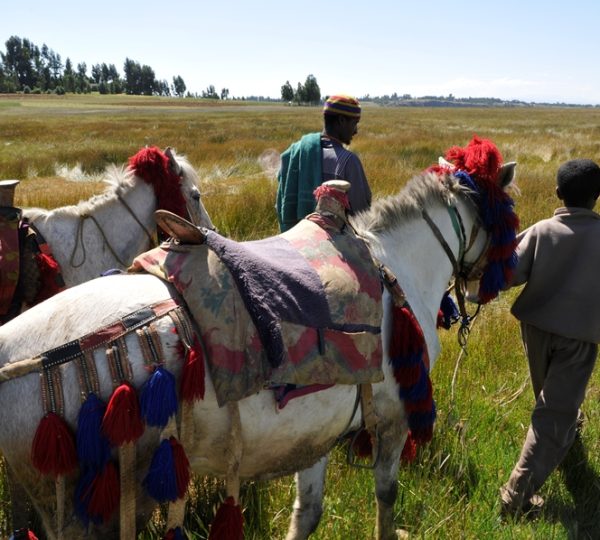
Most of the walking is on the flat or with short or gentle gradients, but some walks do take all day (with stops). For those unsure of wanting to walk all day, horses can be hired. These will be tough local ponies, but not really suitable for heavy people (over 80kgs) and not comfortable for those with long legs .
Your Luggage
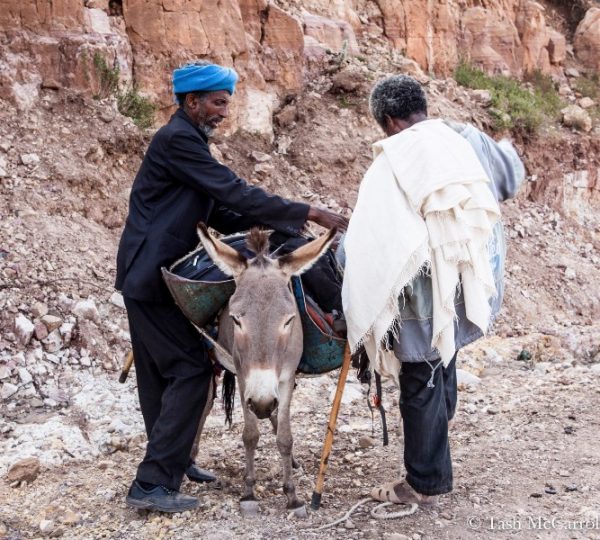
Porters and donkeys/mules will be on hand to move your belongings from where you are dropped by car to each site and on to the rendezvous with the car. However please keep the amount to a reasonable limit (1 bag each), and please if possible pack in soft bags.
Health
There is no malaria at the Meket sites, being 1,000 meters above the 1,800 limit of the malarial mosquito. Although not as high, Lalibela, Gondar and Axum are also above the malarial cut-off point. More likely to be a problem are tummy bugs, often just from unfamiliar food. Some precautions are worth taking. A basic medical kit is available in Meket and local clinics sell many items (paracetamol, plasters etc cheaply) however it may be a good idea to bring some medicines such as Imodium in case of a tummy upset.


