
Historic Route, Semien Mountains, Omo Valley and Yabello-18 days
Explore Tours
Trip Code: ZET 035
Mode of Transportation: Air &Surface (4WD)
Tour Type : Historic route & Omo Valley
Length: 18 days / 17 nights
Group Size: 1- 20 Participants
Dates: Any date departure
Historical Route,Omo and Yabello -18 days
Atop the Ethiopian Highlands, you are standing on the very roof of Africa. This vast high-altitude plateau, marked with volcanic peaks and rent with deep gorges, is one of the world’s most dramatic landscapes. Its soaring crags and rock formations have been described as “the chess pieces of the gods.” Where the escarpment falls away on one side, the gash of the Rift Valley is revealed far below. Rare endemic wildlife such as walia ibex, mountain nyala, Ethiopian wolf and gelada baboons roam the alpine moors and grasslands among these evocative mountains, while raptors soar overhead. Far below, ancient monuments and ruins stand in testament to Ethiopia’s rich human history, once one of the greatest kingdoms on Earth
Take a journey through time by visiting the northern classic historical route of Ethiopia taking you to the rock-hewn churches of Lalibela, Gondar’s castles and the ancient town of Axum.
To the south the Omo Valley awaits you with its intriguing–tribes and landscapes. Spend some time enjoying natural surroundings and game viewing in the Great Rift Valley Lakes area.
Included/Exclude
Tour Amenities
Tour Plan
Upon arrival in Addis Ababa, you will be met and transferred to Hotel. –Addis Ababa means “new flower” in Amharic, and it is Ethiopia’s largest city. Sitting at an elevation of about 2,500 meters above sea level. today vist to a local synagogue and St. Georges Cathedral, Tomoca’s coffee house, the Red Terror Martyr’s Museum, a moving tribute to the suffering of Ethiopians during the 1970’s Mengistu-era persecution .–in the afternoon , tour Haile Selassie’s former palace, which is now the home of the Ethnological Museum. Exhibits here represent the best arts and crafts of the country and give an in-depth view of the various peoples of Ethiopia. – Finally, visit the National Museum, considered by many to be the best museum in Africa. Here, cultural and archaeological relics, including a plaster cast of “Lucy,” the 3.2 million-year-old hominid, are displayed. –At the end of the day, you have the opportunity to drive through the Mercato, which is said to be Africa’s largest open-air market. Rumor has it that you can bargain for anything, even a new soul! Time permitting, visit Churchill Street, known for its many curio shops selling traditional Ethiopian crafts and fine quality silver and cotton.
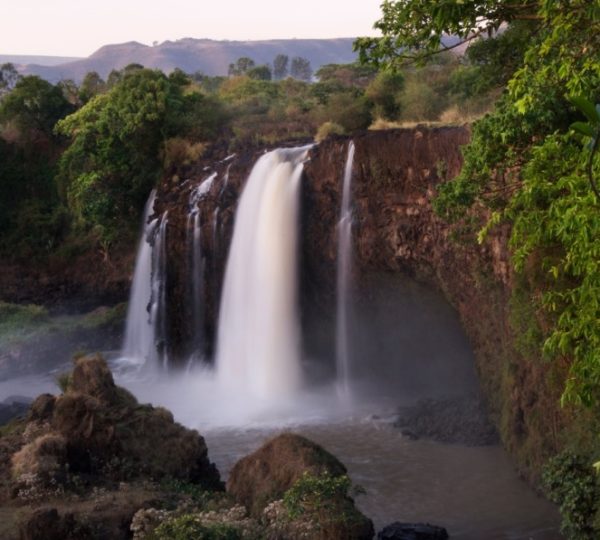
Fly from Addis to Bahir Dar and visit the Blue Nile Falls before lunch. In the afternoon, enjoy a boat trip on Ethiopia’s largest water body – Lake Tana (3,600–Km Sq) to visit the island monasteries of Ura Kidane–Mihret (14th Century AD) and Azwa Mariam (14th Century AD).
Meals: B,L,D
Overnight Hotel
Drive from Bahir Dar to Gondar – the 17th century capital of Ethiopia. In the afternoon, visit the Imperial Castle Compound of Gondar (UNESCO World Heritage Site), the ‘Bath of Emperor Fasiladas’, the church of Quskuam Mariam (17th century AD), the residence of Empress Mintwab, and the church of Debre Birhan Sillassie which is famous for its wall and ceiling paintings.
Meals: B,L,D
Overnight Hotel
Drive from Gondar to Debark (the headquarter of the Simien Mountain National Park), and proceed 36 km farther to the Simien Mountains (UNESCO World Heritage Site) to view the endemic mammal of Ethiopia – the Gelada Baboon, and the breath-taking scenery of the Simien Mountains.
Meals: B,L,D
Overnight Lodge or Hotel
Drive to Axum – Continue on the rugged road for a full day’s drive to the fabled city of Axum via the lowlands of the Simien Mountains and Tekeze River gorge. Though this is a long journey, the spectacular views make time slide away. Arrive in the late afternoon with time to enjoy the beautiful sunset from the hotel terrace.
Meals: B,L,D
Overnight Hotel
Have a sightseeing tour of Axum which includes visiting the Archaeological museum of Axum, the famous stele park (UNESCO World Heritage Site), the church of St. Mary of Zion which is believed to be the last resting place of the original Ark of the Covenant, the palace and tomb of King Kaleb and Gebre Meskel (6th Century AD) as well as the ruin palace of the Queen of Sheba (9th Century BC).
Meals: B,L,D
Overnight Hotel
In the morning, fly to Lalibela — home of the 12th century AD rock hewn churches of King Lalibela. In the afternoon you get to visit the first group of churches of King Lalibela (UNESCO World Heritage Site).
Meals: B,L,D
Overnight Hotel
In the morning, mule back ride to the hill top semi monolithic church of Asheton Mariam (12th century AD). Getting to the top of the hill rewards with great and unforgettable scenery of the area. In the afternoon, visit the remaining second and the third group of the churches of Lalibela.
Meals: B,L,D
Overnight Hotel
Return to Addis Ababa by air in the morning. Continue the safari by road and drive 200 km south of Addis to the Great Rift Valley. the Lake Langano recreational areas, the Abiyatta Shalla lakes national Park attracts numerous visitors. It was created primarily for its aquatic bird life, particularly those that feed and breed on lakes Abiyatta and Shalla in Large numbers. Abiyatta is surrounded by gentle, grasscovered slopes and swathed in acacia woodlands. Shalla exudes a sense of mystery and foreboding, surrounded as it is by steep, black cliffs and peaks that reflect in its deep waters, which are liable to be whipped up by sudden storms and flurries of wind. It contains nine small, is located islands, rarely visited since there are no boats on the lake. These islands provide an excellent breeding ground for many bird species. Birdlife: Abijatta itself is very alkaline but shallow, so flamingoes can be seen scattered over most of its surface, and especially along the windward edge where their algal food source concentrates. You can approach quite closely, but beware of treacherous deep and mud if the lake is low. Large numbers of boat grater and lesser flamingoes gather here, together with great white pelicans and a host of other water birds. Wildlife From here you can see other parts of Lake Abiyatta and some mammal species, especially Grant’s gazelle, warthog and occasionally the Oribi.
Meals: B,L,D
Overnight Hotel
Drive from Langano to Arba Minch through the fertile land of Wolita and Alaba regions. The Alaba people are very famous for their beautiful home painting style. En- route visit Sinkile Wild life Sanctuary where you will see the endemic Swayne hartebeest and other mammals.
Meals: B,L,D
Overnight Hotel or Lodge
After breakfast drive to Chencha to visit Dorze village. The Dorze people are well known for the weaving tradition and their attractive elephant shaped traditional hut made from bamboo and false banana tree leafs. Here you will also see the daily activity of the Dorze people. Return to Arba Minch for lunch. In the afternoon you will take a boat ride on Lake Chamo, one of the Rift Valley Lakes. Visit the Crocodile Market where you can see large number of crocodiles, different aquatic birds and hippos.
Meals: B,L,D
Overnight Hotel or Lodge
Drive from Arba Minch to Jinka and make a stop at colourful Key After Thursday market where the Ari, the Tsemay and the Benna people meet.
Meals: B,L,D
Overnight Hotel or Lodge
Make an excursion trip to Mago National Park. Visit the most famous people of the Omo Valley – the Mursi people, whose women are typically known for their clay lip plates they insert in their lower lips. Continue to Jinka to visit the cultural museum of the Omo people.
Meals: B,L,D
Overnight Hotel or Lodge
Drive from Jinka to Dimeka to visit the Saturday market of the Hamer people. Continue to Turmi for overnight. Visit the cultural village of the Hamer people in the Turmi area. The Hamer people are famous for their typical hair dressings which the women decorate with red soil and butter.
Meals: B,L,D
Overnight Hotel or Lodge
Today you are taken on an excursion to Omorate. You cross the Omo River by boat in order to visit the Dasenech people who are known for their body scarification. Spend the afternoon at leisure in Turmi.
Meals: B,L,D
Overnight Hotel or Lodge
The safari continues by road from Turmi to Yabello where you will visit the Erbore people and the Konso people.
Meals: B,L,D
Overnight Motel
Drive from Yabello to Awassa to visit the nomadic Borena people and the Sidama people, who are noted for their cultivation of False Banana (Enset). Visit the coffee plantations around Yirga Chefe en- route where some of Ethiopia’s most flavoured coffee beans grow. Late afternoon you have time to enjoy bird watching and a sun set over the Rift Valley Lake of Awassa.
Meals: B,L,D
Overnight Hotel
You will go down to the shore of Lake Awassa this morning to view the ‘Fish Market’. Return to Addis Ababa by road (273 km). A half-day city tour of Addis Ababa is planned for the afternoon. Places you will visit on the tour include the National Archeological Museum of Addis Ababa, Merkato – the largest open-air market in Africa and a drive up Mt. Entoto (3,500 meters) for a panoramic view of the capital. This evening you will be treated to a fare well dinner party at one of the best traditional restaurants of Addis. You get to view traditional dances of the Ethiopian people and taste a variety of Ethiopian dishes.
Enquire for options to extend your stay with a Simien Mountain hike or other areas in Ethiopia, please enquire.
This trip can be tailor made throughout the year to suit your requirement.
Not finding what you are looking for? We'll customize your itinerary for you!
Date and Availability = All the year This trip can be tailor made throughout the year to suit your requirement and itinerary can be adjusted according to your time, budget and interest. Price: , if you want quotation or any other tour information about this trip we are very happy to help. Request a quote
suit your requirement and itinerary can be adjusted
Trip Notes
Equipped with the best vehicles and driver Guide / upon request you will be escorted by expert guides /you are immersed in the ancient history, cultures, natural habitats and spiritually of this captivating country and its people. This itinerary can easily be modified as a custom trip and if your travel dates are flexible we recommend visiting Ethiopia in conjunction with the colorful Timkat( epiphany ) and Gena( x-mass) festivals January 19 and 7 respectively
Essential information
Plan your trip
Getting around Ethiopia
Road: The best way to experience the variety of scenery Ethiopia has to offer is travel by road. Ethiopia's road network has improved substantially in the past decade or so thanks to an extensive road maintenance programme and many roads are become an asphalt.
There are a several highways in Ethiopia, majority of the roads are in good condition:
The major roads leading out from Addis Ababa are tar-sealed, all-weather roads along all (or most of) their routes. Many minor roads are paved and traversing them can be comfortable.
By car: -A good way to tour Ethiopia is by car. They can take you off the beaten track so you can see the beauty and attractions of Ethiopia.
We use reliable and well maintained Toyota Landcruisers, Buses and minibuses throughout the entirety of this tour and our drivers are chosen by us for their skills, their safety, their experience and their good nature. The main roads in Ethiopia are often newly tarmaced and facilitate comfort and efficiency. But this tour frequently goes off-piste to explore much more unusual areas, making the comfort and quality of our vehicles of utmost importance.
Vehicles /Transport: During the course of your trip, we will use a variety of vehicles, all which are fit for purpose and the conditions encountered. We will be using a 4WD Toyota land cruiser, mini buses or coater buses depending on the condition of the road and the size of the group.
These land cruisers can accommodate four to five participants. Travelling in Ethiopia is a great adventure and needs much patience and flexibility. The quality of the bus is not always comparable with the standards that you are used to in the West
Travel documents (Passport and Visa requirements)
Your passport should be valid for at least 6 months after having left Ethiopia. Also keep in mind that your passport needs at least 2 consecutive blank pages. A photocopy of your passport is a great idea (keep it somewhere separate in your luggage).
At present, a visa is required for entry as a tourist into Ethiopia. You should apply to your nearest Ethiopian embassy . For some nationalities it's possible to obtain a tourist visa on arrival into Addis Ababa airport, visitors will need to bring two recent passport-sized photographs. Please check the visa requirements for your country well in advance of travel as they can of course change at any moment.
Upon request we arrange visas for our travellers, or if an invitation letter is necessary then we will arrange this for you.
There are no mandatory vaccination requirements
When is best: The Ethiopian Tourist Board proudly promotes their slogan “13 months of sunshine” to anyone who will listen, but they are not far off the mark. The rainy season in the North is in July and August, but whilst that might stop you attempting a multi day trek in the Simien Mountains, it won’t really affect you if you are planning on touring the Northern Historical route. The best time to visit the North is in Autumn, after the rains when the mountains are full of lush green and the views are in impeded by haze.
When to go — All year round
Accommodation: Currently, Ethiopia is known for its fine and luxurious hotels and Lodges . Reliable hot showers are generally speaking still a luxury and places with genuine charm are available. All accommodation throughout this tour is 2 -4 star (comfortable hotels with en-suite facilities) accommodation is based on twin sharing but single supplements are not compulsory. If you prefer not to pay a single supplement we’ll pair you with someone else of the same sex for you to share with throughout the trip. Single rooms are available (at an extra cost) But these must be booked and paid in Advance.
Food :-A wide variety of western different dishes are available in Ethiopia. Eating out is very good value in Ethiopia and there are excellent restaurants to explore. On a tour like this we usually feel .
Private groups: The adventures featured in our itinerary are just a starting point for many of our private group travellers. Working closely with our Groups Department we can organize custom designed itineraries for groups of friends, clubs, charity’s, schools or even work colleagues. Our team will assist you with all aspects of your private group adventure from itinerary design to group flights. For group traveller pledge considerable discount.
Customized tours: On request, this tour can be customized for small groups.
Proceeding / additional days: It's no problem to add days before or after the expedition and we'll book these for you. If you bring more time, you could do day trips from Addiss or take an extension tour
Group booking discount: If at least 5 people together book this trip, 6% discount is given.
Please remember that all Zagwee Ethiopia tour prices mean NO hidden extras, NO local payments.
Please remember that all Zagwee Ethiopia tour prices mean NO hidden extras, NO local payments and NO compulsory single supplements
Responsible tourism:-This trip is a great opportunity to see Ethiopian endemic species of Gelada.
The trip also gives employment and a market opportunity for the local shop owners, markets, restaurants, guides, scouts, mule hires, and many more. Also all the accommodations throughout your trip are owned and run by the members of the local community. Your needs associated with your travel will be served by the members of the community.
Festivals
To a large extent the Ethiopian Orthodox church determines life in the highlands. They celebrate festivals for the principal saints at appropriate times and the largest Christian events are annually commemorated. Religious festivals are associated with long hours of church service and attractive processions through the streets of towns and villages, preceded by priests in the most colourful robes. They have other attributes such as beautifully decorated silver crosses and effigies of saints. The most important festivals are:
TIMKAT FESTIVAL - LALIBELA
Each year in Ethiopia on 18th and 19th January in exuberant manner, the Timkat or 'Ethiopian Baptism Party' is celebrated in honour of the baptism of Jesus by John the Baptist in the River Jordan.
Timkat is the most important festival in Ethiopia. In processions throughout the country, the Ark of the Covenant (replica) is carried for 2 days before being put away. The ceremonies are the largest and most important in the royal city of Gondar, whilst Lalibela is the beautiful place to see the most original displays. Throughout the year pilgrims visit Lalibela, but in the days before and during Timkat it is really overwhelmed by the faithful who wish to attend the procession.
Everywhere in this country are replicas of the tabot, the Ark of the Covenant containing the tablets of Moses. The priests wear gorgeous satin robes. The tour takes you past most churches, where priests join in, each with their own replica of the tabot and a brightly coloured parasol. The tour ends at the banks where there are night prayers, drumming and singing. At sunrise the baptism ritual is carried out . After replicas are soaked, adults and children are brought to the water to be baptized. In Gondar the multitudes jump en masse into the bath which once belonged to the 14th-century emperor Fascilida. After this ritual the procession begins to move on and you see the row of coloured parasols slowly creep up the mountainside.
MESKEL FESTIVAL - ADDIS ABABA
Meskel is celebrated in September, one of the country's most colourful Christian festivals, where thousands of Ethiopians and tourists gather. Meskel is celebrated on the day on which St. Helena recovered Jesus' cross and brought it back to Ethiopia. This festival is about 1600 years old. On the eve of Meskel, large bonfires are lit, decorated with pretty Meskel daisies in different shades of yellow. The flowers symbolize the end of the rainy season and the return of the sun. Priests are in full regalia and their followers, dressed in virginal white, are singing and dancing around the fire.
LEDDET FESTIVAL - LALIBELA
The Leddet Festival (Ethiopian Christmas) in Lalibela is a lavish celebration. Here you will find underground, eleven monolithic churches and a chapel, connected by a corridor. The churches are decorated with beautiful frescoes. In and around the churches you will find countless priests, devout Christians and pilgrims in white robes. A service in one of the churches is a special experience. The smell of incense, the chanting of the worshipers, candlelight, the music of drums, rattles and whistles that echo through the high arches give it a mystical, magical atmosphere.
Leddet falls on 29th December on the Ethiopian calendar (January 7 according to our Gregorian calendar). It is celebrated after a period of 43 days of fasting called Tsome Gahad (Advent), with a spectacular procession. It begins at 6 pm and continues until the next morning at 9 o'clock. After this marathon, people collectively go home to break the fast by eating chicken, lamb or beef. All this is accompanied by injera (sour pancakes) and traditional drinks like tea and tella (kind of beer). Traditionally, young men play a game called Genna, which is most similar to hockey. The game dates from the time of Jesus and was played mainly by shepherds.
If you are one of the lucky ones invited to celebrate with a family, take a goat as a Christmas gift or a bottle of tej (honey wine) it. It is advisable not to eat much beforehand. Indeed, it is expected of you that you only stop eating and drinking once everything is exhausted!
PLEASE NOTE: The itineraries can be modified during the festival departures.


